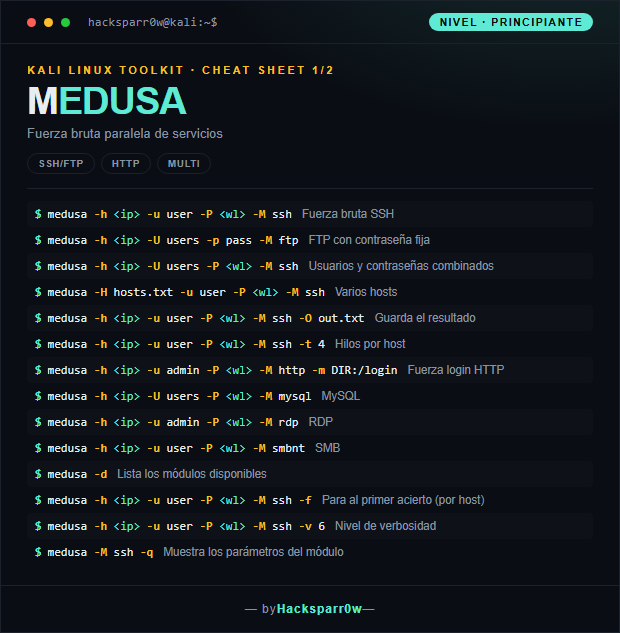
Medusa is a modular, parallel brute-force login cracker that tests credentials against network services such as ssh, ftp, http, smbnt, rdp, or databases. Its strength is firing many simultaneous attempts against one or several hosts at once, each service through its own module (-M).
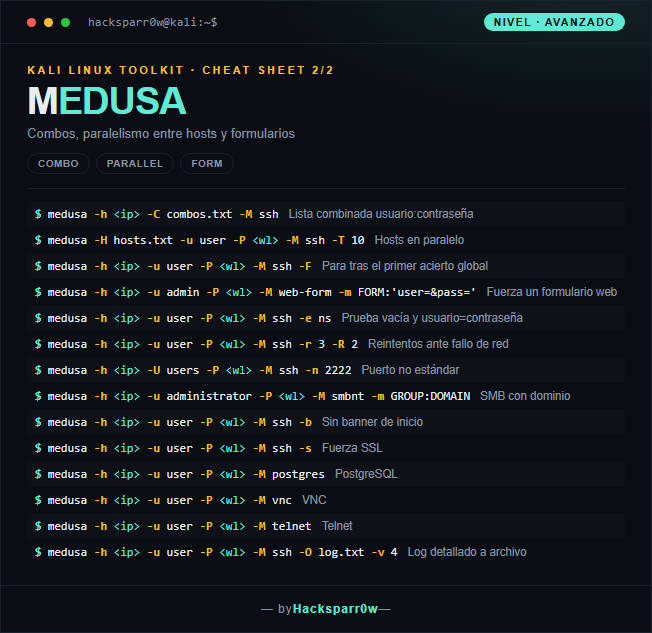
Medusa parallelizes along two axes at once: -t opens several threads against a single host and -T tests several hosts in parallel, so the number of simultaneous connections is the product of both. Grasping that multiplication is key to avoid saturating the network or triggering account lockouts. Combo files (-C) let you test specific user:password pairs instead of the cartesian product of -U by -P.
Don't confuse -t (threads per host) with -T (hosts in parallel): the total of simultaneous connections is the product of both, and setting it too high saturates the network or triggers lockouts.
-f stops at the first hit per host; -F stops the whole run at the first global hit. They are different things.
Before building the -m for http or web-form, run medusa -M <module> -q to see the exact parameters that module accepts (FORM, DIR…).
-H expects a host file, not a bare IP; for a single target use -h. Mixing them causes the input to be ignored.
Account lockout is real: SSH, SMB, or RDP often lock after a few failures. Lower the threads and use -r/-R for network retries instead of hammering.
Responsible use
These commands are for systems you own or have explicit written authorisation to test (labs, CTFs, contracted engagements). Using them against third-party infrastructure without permission is illegal in most countries.
Medusa es un cracker de login por fuerza bruta modular y paralelo que prueba credenciales contra servicios de red como ssh, ftp, http, smbnt, rdp o bases de datos. Su fuerte es lanzar muchos intentos simultáneos contra uno o varios hosts a la vez, cada servicio a través de su módulo (-M).
Medusa paraleliza en dos ejes a la vez: -t abre varios hilos contra un mismo host y -T prueba varios hosts en paralelo, así que el número de conexiones simultáneas es el producto de ambos. Entender esa multiplicación es clave para no saturar la red ni disparar bloqueos de cuenta. Los ficheros de combos (-C) permiten probar pares usuario:contraseña concretos en lugar del producto cartesiano de -U por -P.
No confundas -t (hilos por host) con -T (hosts en paralelo): el total de conexiones simultáneas es el producto de ambos, y subirlo de más satura la red o dispara bloqueos.
-f para al primer acierto por host; -F para toda la ejecución al primer acierto global. Son cosas distintas.
Antes de montar el -m de http o web-form, lanza medusa -M <módulo> -q para ver los parámetros exactos que acepta ese módulo (FORM, DIR…).
-H espera un fichero de hosts, no una IP suelta; para un único objetivo usa -h. Mezclarlos hace que se ignore la entrada.
El bloqueo de cuentas es real: SSH, SMB o RDP suelen bloquear tras pocos fallos. Baja los hilos y usa -r/-R para reintentos de red en vez de martillear.
Uso responsable
Estos comandos son para entornos propios o con autorización explícita por escrito (laboratorios, CTF, auditorías contratadas). Usarlos contra infraestructura ajena sin permiso es ilegal en la mayoría de países.